The Coca-Cola Route — oldest path with hut accommodation
You will be picked up at the Kilimanjaro International Airport (JRO) by an Ahsante Tours representative and transferred to your hotel in Moshi town. The drive from the airport takes approximately 45 minutes through lush green landscapes with Mount Kilimanjaro towering majestically in the distance. Once at the hotel, you can relax, settle in, and enjoy the warm hospitality of Moshi. Later in the afternoon, your professional mountain guide will meet with you for a thorough briefing about the upcoming trek on the historic Coca-Cola Route. The guide will walk you through the entire itinerary day by day, discuss what to expect at each hut, explain the acclimatization process, and answer any questions you may have. An equipment check will be conducted to ensure you have all the necessary mountain gear. Any missing items can be rented locally at affordable prices before we depart tomorrow morning.
After breakfast, you will be collected from your lodge in Moshi and taken to the Marangu Gate at 1,860m, which also serves as the headquarters of Kilimanjaro National Park. This is historically significant as the starting point used by Hans Meyer during the first successful Kilimanjaro summit in 1889. Once the necessary paperwork has been completed and park fees paid, your trek can begin. You will soon be hiking through the dense tropical rainforest, one of the most beautiful and biodiverse sections of the entire route. Alongside the impressive vegetation including towering trees, colorful ferns, and hanging mosses, you will have the chance to catch a glimpse of some primates including Black and White Colobus monkeys and various bird species as you head to the Mandara Hut. The trail is well-maintained and the gradient is gentle, making it an enjoyable start to your Kilimanjaro adventure. After a well-earned rest at Mandara Hut, your guide can take you to the Maundi Crater, an extinct volcanic crater where you can enjoy wonderful views of the Kenyan interior stretching to the horizon.
The day begins with an early breakfast at Mandara Hut. Shortly after you have left the hut, you will reach the timberline where the dense rainforest gives way to a completely different landscape. You then enter the heath and moor zone, a fascinating transitional environment where giant heather trees, erica plants, and giant lobelias dominate the scenery. The trail is well-defined and the gradient is steady but manageable. Approximately 4 to 6 hours later, the Horombo Hut will come into sight, standing at an altitude of 3,700m. This is one of the most atmospheric camps on Kilimanjaro, with wooden huts nestled among the moorland vegetation. From the hut, you will have fantastic panoramic views overlooking the jagged peaks of Mawenzi, the icy summit of Kibo, and the wide plain of the Masai steppe stretching into the distance. The sunset from Horombo Hut is particularly spectacular, painting the sky in shades of orange, pink, and purple over the African landscape.
Today serves as a crucial acclimatization day, and this should not be underestimated as it greatly improves your chance of success in reaching the summit. After a relaxing breakfast at Horombo Hut, a 4-hour trek follows to the Zebra Rocks at 4,020m. The distinctive black and white stripes that give this rock formation its name are caused by mineral deposits and lichen growth, creating a natural work of art that is truly unique to Kilimanjaro. The trek to Zebra Rocks takes you through increasingly sparse vegetation into the upper moorland zone, where the landscape becomes more barren and volcanic. The views from this altitude are absolutely stunning, with clear sightlines to both Kibo and Mawenzi peaks. On your return to Horombo Hut, a warm lunch will be waiting for you. You can relax in the afternoon and regain your strength for the challenging hike to Kibo Hut the following day. This acclimatization day is what separates the 6-day Marangu Route from the shorter 5-day version, and significantly improves your chances of a successful summit.
Today stage is long and tough, taking you from the moorland zone into the barren alpine desert. The well-built trail passes the Last Water Point, the final reliable water source before the summit, before entering the so-called Saddle. This nearly vegetation-less plateau joins the main summit Kibo with the jagged peaks of Mawenzi, creating a dramatic and otherworldly landscape. The terrain is stark and lunar-like, with volcanic rock and dust stretching in every direction under the brilliant African sky. The climb is steady but demanding, and the altitude makes every step more challenging. Todays destination is the Kibo Hut at 4,700m, which is usually reached in about 5 to 6 hours. Here, you will enjoy an early evening meal followed by an early night, as the night will be short. You will be woken between 11pm and midnight to begin the final summit attempt. The anticipation builds as you lie in your hut, knowing that in just a few hours you will begin the final push to the roof of Africa.
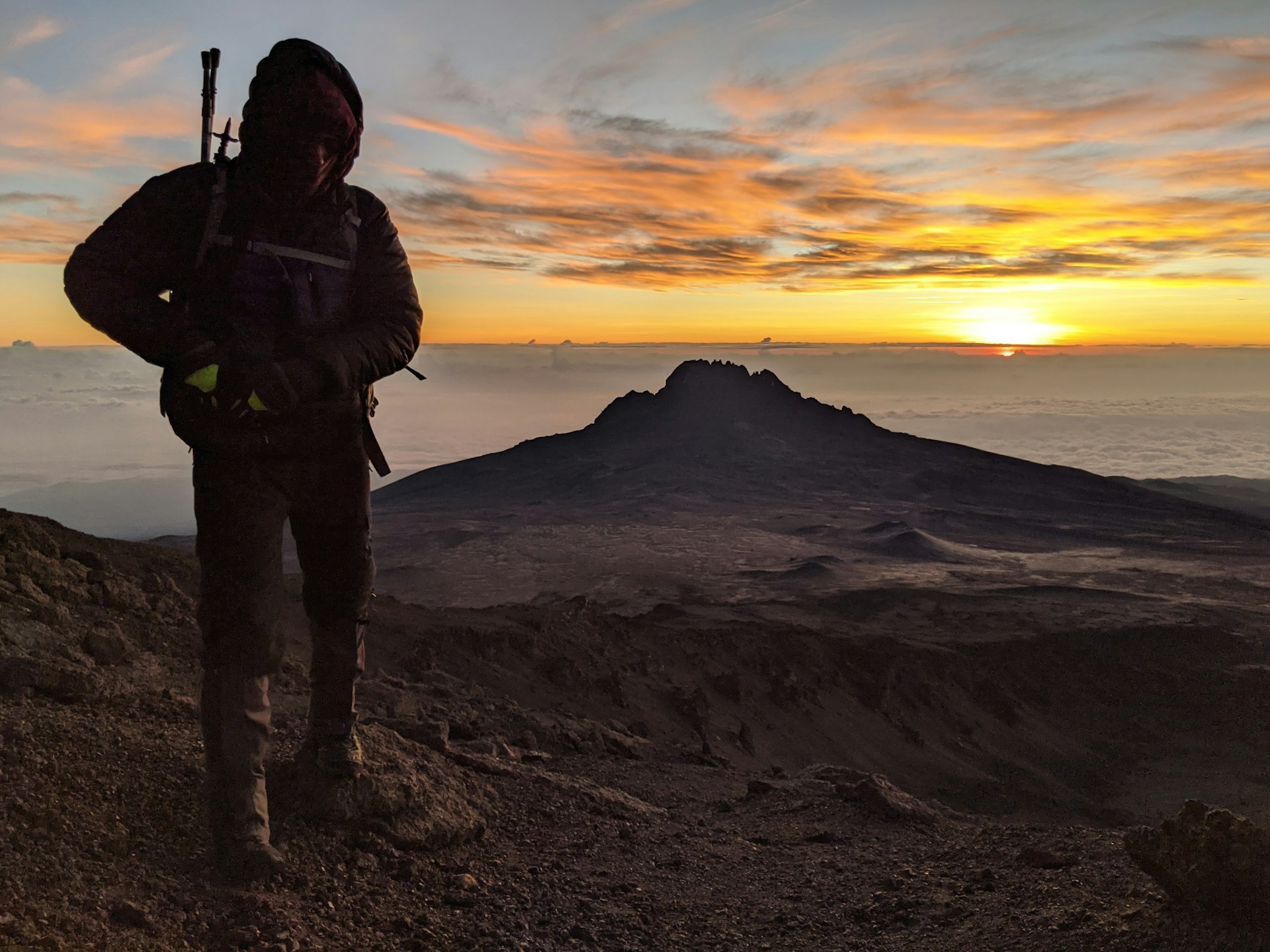
Today is The Big Day, the summit stage. You will begin your final ascent around midnight, walking steeply upwards by headlamp through the darkness. The climb is long and strenuous, ascending through scree and volcanic rock for 4 to 5 hours. Passing the Hans Meyer Cave at 5,220m, where the famous German geologist first explored Kilimanjaro crater in 1889, the climb slowly but surely goes upward. At sunrise, you will reach Gillman Point at 5,681m, the crater rim of Kilimanjaro, where the sun will slowly start to warm up the land. The moment when the first rays of sunlight illuminate the African landscape below is one of the most magical experiences you will ever witness. You will have soon forgotten the cold of the night as warmth spreads across the crater rim. Spectacular ice cliffs within the crater surround us and the views to jagged Mawenzi peak and beyond are absolutely breathtaking. After a further hike of 1 to 2 hours along the crater rim, you will reach Uhuru Peak at 5,895m, the highest point in all of Africa. Standing on the summit, surrounded by glaciers and the vast African landscape stretching to the horizon, is an experience that will stay with you forever. On your return to Kibo Hut, a warm meal awaits you followed by a 1 to 2-hour break before proceeding back down to Horombo Hut for the night.
The last stage of our incredible journey passes through the heath and moor zone to the Mandara Hut at 2,700m, where a warm lunch is waiting for you. The descent is gentle and allows you to reflect on the extraordinary achievement of reaching the summit. As you continue downward, you will once again pass through the tropical rainforest, a welcome change from the barren landscapes of the higher altitudes. The sounds and smells of the forest are a beautiful contrast to what you have experienced over the past week. After a total time of approximately 6 to 7 hours of trekking, you will arrive back at the Kilimanjaro National Park Gate (Marangu Gate) at 1,860m. Here, you will say goodbye to your mountain guides and porters who have supported you throughout this life-changing journey. A short transfer follows to take you back to your hotel in Moshi. Once there, you can take a warm and relaxing shower and celebrate your success in reaching the summit of Kilimanjaro. The celebration dinner at the hotel is a wonderful way to mark this incredible achievement.
The day is left free to wind down after the trek before your flight home. Depending on your flight times, you could explore Moshi town and pick up some souvenirs before heading to the airport. We also welcome you to spare an hour of your day to plant a tree as part of our environmental conservation efforts in the Kilimanjaro region. Safari and Zanzibar add-ons are available if you wish to continue exploring Tanzania after your incredible Kilimanjaro experience.
Join thousands of climbers who have reached the Roof of Africa. Your adventure starts here.