The quietest route on the northern side with fewer crowds and 70% success rate
You will be picked up at the Kilimanjaro International Airport (JRO) by an Ahsante Tours representative and transferred to your hotel in Moshi town. The drive from the airport takes approximately 45 minutes, passing through lush green landscapes with Mount Kilimanjaro towering in the distance. Once at the hotel, you can relax and settle in. Later in the afternoon, your professional mountain guide will meet with you for a thorough briefing about the upcoming trek. The guide will walk you through the entire itinerary, discuss what to expect at each camp, and answer any questions you may have. An equipment check will be conducted to ensure you have all the necessary mountain gear. Any missing items can be rented locally at affordable prices.
This morning, we will drive to the village of Nale Moru, which serves as the starting point of the Rongai Route on the northeastern side of Mount Kilimanjaro near the Kenyan border. The drive takes approximately two hours through picturesque farmland and local villages. Upon arrival at the Nalemoru Gate (1,990m), we complete the park registration formalities before commencing our trek. The first stage of the journey takes us through beautiful farmland and dense pine forests. The trail is relatively gentle and allows you to ease into the rhythm of trekking. As you walk through this pristine environment, you may have the chance to spot the beautiful Black and White Colobus monkeys swinging through the treetops. If you are exceptionally lucky, you might even catch a glimpse of elephants or buffalos moving through the forest. The path gradually ascends through the cultivated zone before entering the heath and moorland zone. Our first camp, Simba Camp, is located at the edge of the moorland zone at 2,625m, offering stunning views of the surrounding landscape and your first real taste of sleeping on the mountain.
After an early breakfast at camp, we set off on a steady ascent through the moorland zone. The morning hike takes us along a well-defined trail that gradually gains altitude. As we climb higher, the vegetation becomes more sparse and the landscape transforms dramatically. The pine forests give way to open moorland with giant lobelias and groundsel plants scattered across the terrain. The highlight of today trek is the superb panoramic views of Kibo Peak, the highest of Kilimanjaro three volcanic cones, and the Eastern ice fields that shimmer on the crater rim. On a clear day, these views are absolutely breathtaking and provide excellent photo opportunities. The trail is well-maintained and the gradient is manageable, making it an enjoyable day of trekking. We arrive at the Second Cave Camp in the early afternoon, giving you plenty of time to rest, explore the surroundings, and acclimatize to the altitude.
Leaving the pine forest behind, we carry on with a steady ascent walking through expansive moorland terrain. The landscape today is truly extraordinary. Vast open spaces stretch in every direction, with the towering peaks of Kilimanjaro dominating the skyline. There are continued superb views of the Eastern ice fields on the crater rim of Kibo. As we progress, we leave the main trail and strike out across moorland on a smaller, less-traveled path towards the jagged, dramatic peaks of Mawenzi, the second of Kilimanjaro volcanoes. Mawenzi is a striking sight with its sharp, rocky spires contrasting dramatically against the sky. The path winds through increasingly rugged terrain, passing through areas of unique volcanic rock formations. We will set up camp today in the sheltered valley near the Kikelewa Caves, a fascinating geological feature where ancient lava flows have created natural sheltered formations.
This morning, we have a short but steep ascent up grassy slopes that rewards us with a truly spectacular panorama. To the north, the views stretch across the vast Kenyan plains, which appear to extend endlessly toward the horizon. On clear mornings, you can see far into Kenya, witnessing the dramatic transition from mountain to savanna. As we continue climbing, we leave the vegetation behind shortly before reaching our next camp at Mawenzi Tarn Hut. This camp is located directly below the towering, jagged cliffs of Mawenzi Peak, providing one of the most dramatic camp settings on any Kilimanjaro route. The Tarn itself is a small mountain lake nestled in a rocky cirque, reflecting the surrounding peaks like a mirror. The afternoon is free for you to rest at camp or explore the surrounding area to aid acclimatization.
After a good night rest and breakfast at Mawenzi Tarn, we set off on our walk to Kibo Hut at 4,700m. Today we traverse the saddle between Mawenzi and Kibo, the two main peaks of Kilimanjaro. The climb will take us across desolate, otherworldly scree slopes with absolutely no vegetation around us at all. The landscape is stark and lunar-like, with volcanic rock and dust stretching in every direction. It is a tough, steep walk made more difficult by the altitude, but the sense of accomplishment as you cross the saddle is immense. On arriving at Kibo Hut, we eat and spend the afternoon resting as we prepare for a long night and day ahead. It is absolutely critical to keep hydrated and warm at this altitude. We have an early dinner and then try to get some sleep as we will be getting up between 11pm and 12am to start the climb to the summit.
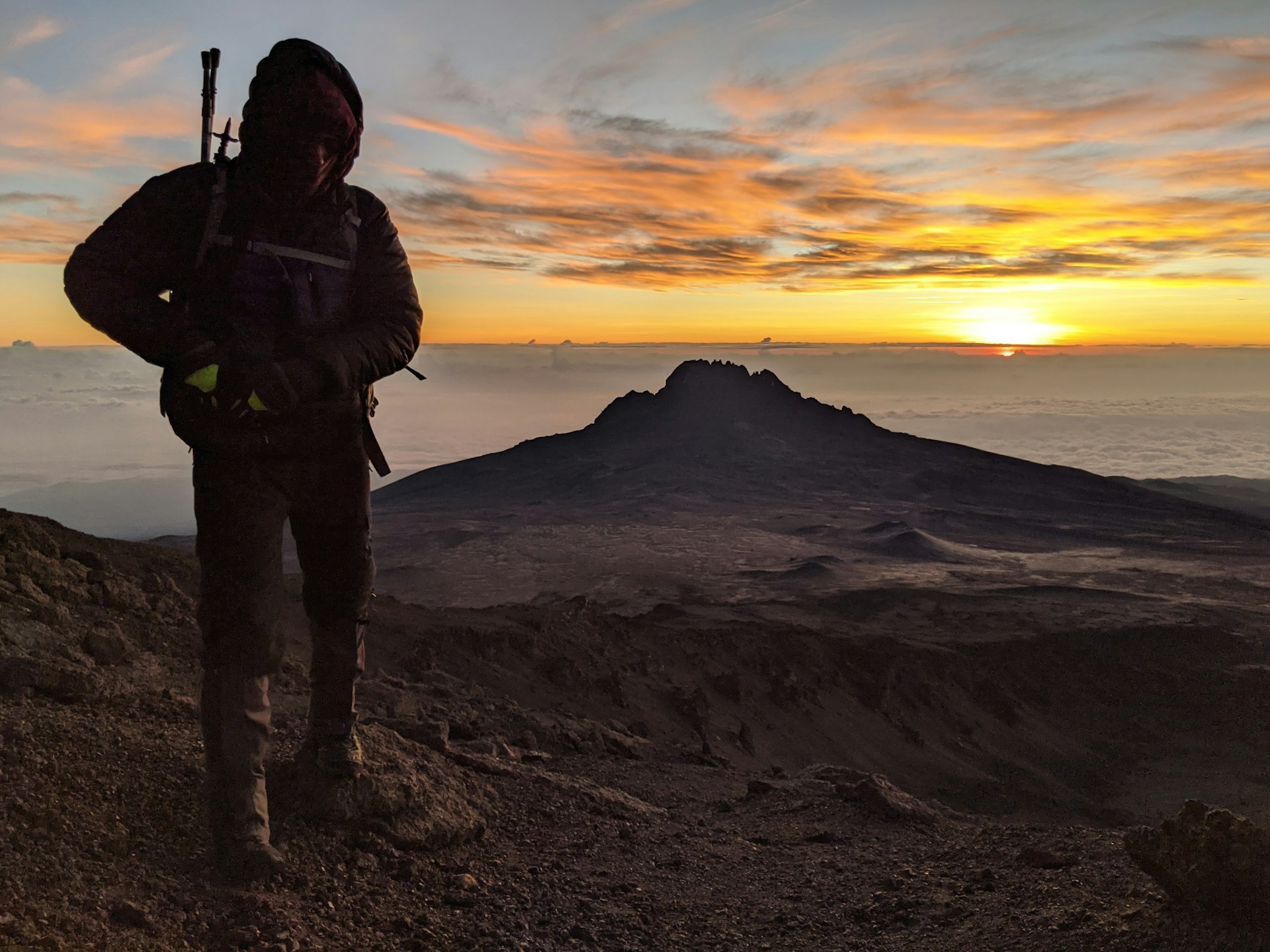
Today is The Big Day, the summit stage. You will begin your final ascent around midnight, walking steeply upwards by headlamp through the darkness. The climb is long and strenuous, ascending through scree and volcanic rock for 4 to 5 hours. Passing the Hans Meyer Cave at 5,220m, where the famous German geologist first explored Kilimanjaro crater, the climb slowly but surely goes upward. At sunrise, you will reach Gillman Point (5,681m), the crater rim of Kilimanjaro, where the sun will slowly start to warm up the land. The moment when the first rays of sunlight illuminate the African landscape below is one of the most magical experiences you will ever witness. You will have soon forgotten the cold of the night as warmth spreads across the crater rim. After a further hike of 1 to 2 hours along the crater rim, you will reach Uhuru Peak at 5,895m (19,340ft), the highest point in Africa. Standing on the summit, surrounded by glaciers and the vast African landscape stretching to the horizon, is an experience that will stay with you forever. On your return to Kibo Hut, a warm meal awaits you followed by a break before proceeding back down to Horombo Hut at 3,700m for the night.
The last stage of our incredible journey passes through the heath and moor zone to the Mandara Hut at 2,700m, where a warm lunch is waiting for you. The descent is gentle and allows you to reflect on the extraordinary achievement of reaching the summit. As you continue downward, you will once again pass through the tropical rainforest, a welcome change from the barren landscapes of the higher altitudes. The sounds and smells of the forest are a beautiful contrast to what you have experienced over the past week. After a total time of approximately 6 to 7 hours of trekking, you will arrive back at the Kilimanjaro National Park Gate (Marangu Gate) at 1,860m. Here, you will say goodbye to your mountain guides and porters who have supported you throughout this life-changing journey. A short transfer follows to take you back to your hotel in Moshi. Once there, you can take a warm and relaxing shower and celebrate your success in reaching the summit of Kilimanjaro.
The day is left free to wind down after the trek before your flight home. Depending on your flight times, you could explore Moshi town and pick up some souvenirs before heading to the airport. We also welcome you to spare an hour of your day to plant a tree as part of our environmental conservation efforts in the Kilimanjaro region. Safari and Zanzibar add-ons are available if you wish to continue exploring Tanzania after your incredible Kilimanjaro experience.
Join thousands of climbers who have reached the Roof of Africa. Your adventure starts here.